Two sandwich panel quotations may both mention a “thickness” number without making clear whether that number refers to the panel or core depth, or to the steel facing. That ambiguity becomes a problem when the buyer expects a specific face-sheet requirement but the quotation was prepared on a different basis. This guide explains how to specify the exterior and interior steel faces separately, how to state whether a value is BMT or TCT, and how to agree on tolerances and verification before the order is placed. It is not a guide to insulation thickness or U-value calculation.
Separate Panel Thickness from Steel Facing Thickness
Panel depth, core thickness and steel facing thickness are distinct specification items:
- Nominal panel depth — identify the supplier’s drawing reference for the overall panel dimension. This may include profile geometry and product-specific conventions.
- Core thickness — the insulation dimension, defined on that same product drawing.
- Facing thickness — each steel sheet, specified separately by side and measurement basis.
Do not assume that overall panel depth always equals core thickness plus two face thicknesses. Profile geometry and product conventions can affect how the nominal panel depth is defined. Before comparing quotations, confirm how the proposed product defines its nominal panel thickness and which dimension is being quoted. The quotation should identify the outer face and the inner face separately, rather than treating “the steel sheet” as a single value. For core and system selection, refer to the sandwich panel materials page.
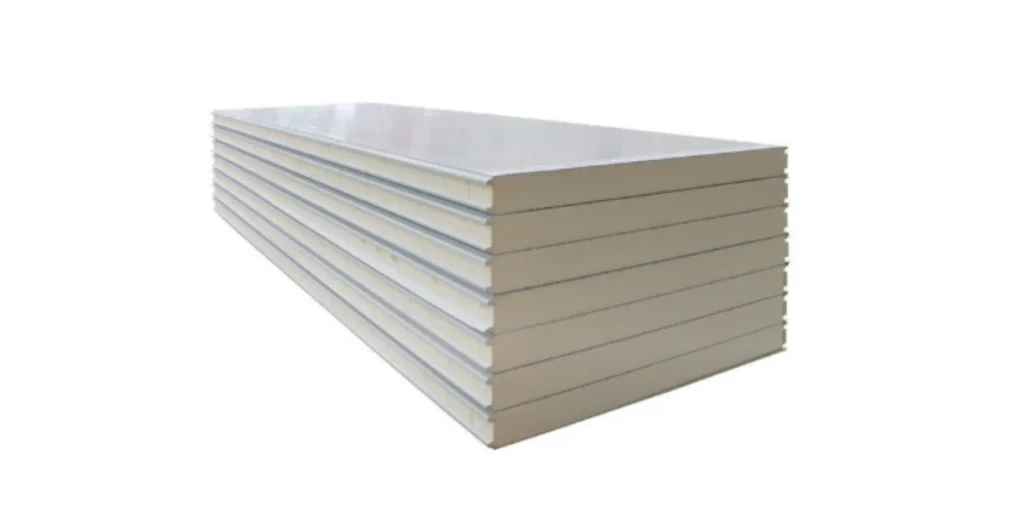
Specify the Exterior and Interior Faces Separately
The exterior face and the interior face should be specified separately. For each side, the buyer should confirm the substrate or material, the steel grade where specified, the nominal thickness and units, the thickness basis, the profile and the finish. The two faces do not have to be equal in thickness, and neither side should be assumed to be thinner or thicker by default. Both faces must satisfy the selected panel system and the project requirements.
A quotation should list each face on its own terms. The buyer should not accept a single number that might refer to only one side. For coated steel sheet and substrate context, refer to the color steel sheet page.
State BMT or TCT and Identify the Coating Layers
BMT means base metal thickness: the thickness of the steel substrate before any coating is applied. TCT means total coated thickness: the overall thickness of the coated sheet under the supplier’s stated convention. These two bases are not interchangeable unless the coating build-up is known and accounted for.
For painted products, the buyer should ask which metallic and paint layers the quoted value includes. A coating mass designation is not itself the steel substrate thickness. Metallic coating mass, organic paint-film thickness and steel substrate thickness are different specification quantities. This guide does not provide a universal subtraction or conversion value, because coating build-ups differ between systems, suppliers and product specifications. Do not convert grams per square metre into a universal millimetre deduction. Where a coating-mass designation is used, ask what convention and surfaces it covers.
Illustrative Example: hypothetical quotations only; not Bingfa stock sizes or an actual customer quotation.
- Supplier A: exterior face 0.50 mm BMT; interior face 0.40 mm BMT.
- Supplier B: exterior face 0.50 mm TCT; interior face 0.40 mm TCT; included layers not yet confirmed.
The numbers alone do not establish equivalent steel substrates. The buyer should request the BMT of each proposed face, which coating layers the quoted TCT includes, the relevant product or coil documentation where available, and the agreed tolerance and acceptance basis. Do not calculate Supplier B’s unknown BMT, use a universal coating subtraction, or infer compliance or non-compliance without the specification.
Agree on Tolerances and Verification Before Ordering
A nominal value is not the same as an agreed tolerance or minimum requirement. Agree the following evidence and acceptance steps before ordering:
- Agree the order specification. Confirm the nominal versus minimum requirement, the applicable tolerance reference, and the document revision that governs the order.
- Request the selected product data and available records. Ask for the product data sheet and any available material, coil or batch records that can be linked to the supplied order. Do not assume a specific certificate or document is available for every order.
- Agree where and when measurement is taken. Confirm the measured quantity (BMT or coated thickness), the suitable equipment or method, the surface condition, and the sampling approach. Include product profile and measurement location in the record. Do not prescribe an unverified instrument setting, fixed sample count, or destructive process.
- Record results against the agreed basis. Identify the responsible person and the disposition of any deviation. A coated-surface reading alone is not independent proof of bare substrate thickness.
A practical record can identify the order or batch, face, product or data-sheet revision, instrument or method, measured basis, location, results and the accepted reference. Confirm which records and methods are available for the offered product. Do not remove coatings from supplied panels without an agreed procedure or apply a tolerance that is not part of the order specification.
Do Not Treat Thickness as a Standalone Performance Approval
Face thickness does not by itself establish permissible span, wind resistance, fire classification, thermal performance or corrosion life. Those characteristics depend on the selected panel system, the core, the connection details, the supporting structure and the applicable product evidence. A thicker face does not compensate for an unsuitable core, an unverified connection or an assembly that has not been assessed for the project. For system-specific support and span verification, refer to the 4m purlin spacing sandwich panel article.
Buyer Worksheet: Confirm the Facing Specification
Use this worksheet to clarify the order. Record nominal panel depth, its reference dimension and the specified core thickness separately above the table. The table is a specification-clarification tool, not an engineering approval.
Nominal panel depth / reference dimension / specified core thickness: ______________________
| Item | Buyer Requirement | Supplier Offered Specification | Supporting Document / Reference | Exception or Clarification |
|---|---|---|---|---|
| Roof/wall product and profile | Exterior: ___ Interior: ___ | Exterior: ___ Interior: ___ | To confirm | To confirm |
| Substrate/material and grade where specified | Exterior: ___ Interior: ___ | Exterior: ___ Interior: ___ | To confirm | To confirm |
| Nominal thickness and units | Exterior: ___ Interior: ___ | Exterior: ___ Interior: ___ | To confirm | To confirm |
| BMT/TCT basis and included layers | Exterior: ___ Interior: ___ | Exterior: ___ Interior: ___ | To confirm | To confirm |
| Tolerance or minimum requirement and governing reference | Exterior: ___ Interior: ___ | Exterior: ___ Interior: ___ | To confirm | To confirm |
| Metallic coating designation | Exterior: ___ Interior: ___ | Exterior: ___ Interior: ___ | To confirm | To confirm |
| Paint/finish requirement | Exterior: ___ Interior: ___ | Exterior: ___ Interior: ___ | To confirm | To confirm |
| Proposed verification method and sampling | Exterior: ___ Interior: ___ | Exterior: ___ Interior: ___ | To confirm | To confirm |
| Available material/order records | Exterior: ___ Interior: ___ | Exterior: ___ Interior: ___ | To confirm | To confirm |
| Agreed exception or substitution requiring approval | Exterior: ___ Interior: ___ | Exterior: ___ Interior: ___ | To confirm | To confirm |
- Quotation / product reference and revision: ______________________
- Evidence / batch reference if available: ______________________
- Acceptance responsibility: ______________________
- Approved deviation: ______________________
Keep unknowns blank. Send the completed or partially completed sheet with the actual panel quotation. For whole-quotation cost and supply scope, refer to the sandwich panel cost guide.
Review Your Sandwich Panel Facing Requirements
Send the proposed panel specification or quotation, roof/wall application, required quantities and project location. Unconfirmed details can be identified for review.
What to Send for a Project-Specific Panel Review
To review a panel specification, send the available quotation or data sheet, the roof or wall application, the project location, quantities, the intended panel or core configuration, the face requirements for each side, and any specified performance documentation. An initial discussion does not require a complete drawing package. If some details are not yet confirmed, the available information can still be reviewed first. Bingfa can review the requested facing specification together with the roof and wall enclosure supply scope. The actual material, processing and documentation scope must be confirmed for the offered product.
Frequently Asked Questions
Is sandwich panel thickness the same as steel skin thickness?
No. Core thickness refers to the insulating layer; nominal panel depth follows the product drawing and may use a different reference dimension. Steel skin thickness describes a face sheet. Identify all three dimensions separately where relevant.
Must the inner and outer steel faces have the same thickness?
Not necessarily. The two faces serve different functions and may be specified differently depending on the project. Neither side should be assumed to be thicker or thinner by default. Both must satisfy the selected panel system and project requirements.
Can I compare one supplier’s BMT with another supplier’s TCT directly?
Not directly. BMT is the base metal thickness before coating; TCT is the total coated thickness. The two bases are not interchangeable unless the coating layers and measurement conventions are known. Ask each supplier to state the basis and included layers.
Does measuring the coated sheet confirm its base metal thickness?
No. Measuring the coated surface gives a coated thickness. Without accounting for the coating layers and the agreed measurement method, it does not establish the bare-metal thickness. The verification method and sampling should be agreed with appropriate technical personnel before production.
Request a Sandwich Panel Quotation
Send your project location, roof or wall application, panel configuration, face requirements and available documentation for a project-specific quotation.