A steel quotation may promise “material certificates” without explaining which documents will accompany the order or how they will relate to the steel delivered. Before accepting that wording, ask a more useful question: can the proposed records demonstrate the material identity and requirements agreed for this purchase?
This checklist helps overseas contractors and procurement teams review a structural steel mill test certificate, identify missing information and agree on documentation before production. It does not establish a universal certificate requirement for every project.
What a Mill Test Certificate Does and Does Not Show
A mill test certificate, often called an MTC or material test certificate, records material identification and inspection information issued by the steel manufacturer. Its exact contents depend on the product, specified inspection document and applicable requirements. A document may identify the grade, heat or batch, product dimensions and test results.
Its value depends on both the information recorded and a defensible link to the supplied material. A technically convincing certificate for a different heat does not establish conformity of your order. Conversely, a component label without supporting records cannot establish the steel’s chemical composition or mechanical properties.
An MTC is not automatically a welding qualification, a coating inspection report, a building approval or proof that every fabricated item has been individually tested. Keep these separate when reviewing the company’s available certificates and quality documents.
EN 10204 Document Types: Confirm the Required Type Before Ordering
EN 10204 describes inspection-document types. It is not a steel grade or a specification for a building. The required document should be agreed against the applicable product specification, purchase order and project requirements, rather than selected because a higher number appears more reassuring.
| Type | What it records | Who validates it |
|---|---|---|
| 2.1 | Statement of compliance with the order; no test results. | The manufacturer. |
| 2.2 | Statement of compliance with results from non-specific inspection. | The manufacturer. |
| 3.1 | Statement of compliance with results from specific inspection. | The manufacturer’s authorized inspection representative, independent of the manufacturing department. |
| 3.2 | Statement of compliance with results from specific inspection. | The manufacturer’s independent authorized inspection representative and either the purchaser’s authorized inspection representative or an inspector designated by official regulations. |
Non-specific results do not necessarily come from the products supplied. Specific inspection concerns the products to be supplied or the relevant test unit defined by the applicable specification. It does not mean that every piece has undergone every test.
A 3.1 certificate is not inherently third-party certification. A 3.2 requirement is not satisfied simply by adding an agency stamp to an existing scan. Confirm the inspection arrangements, authorized parties and required records before ordering; do not assume documentation can be upgraded retrospectively.
Match the Material Specification, Not Just the Certificate Heading
Start with the ordered product: plate, section or another identified form. Compare the stated grade, material-standard edition, delivery condition where applicable, thickness range and dimensions with the approved order. A familiar grade name alone does not establish equivalence to another national standard.
Review the chemical and mechanical results against the specified requirements, including relevant test conditions. For example, an impact-test result cannot be assessed without knowing the required test temperature and acceptance basis. Do not invent a threshold, assume that an omitted test was performed or apply a property requirement from a different thickness range.
Check the issuer, document reference, revision and completeness. If text appears altered or an identifier cannot be reconciled, request clarification and verify the document through an independently established supplier or issuer contact. Do not silently edit the certificate to match the order.
Follow the Link from the Steel to the Fabricated Component
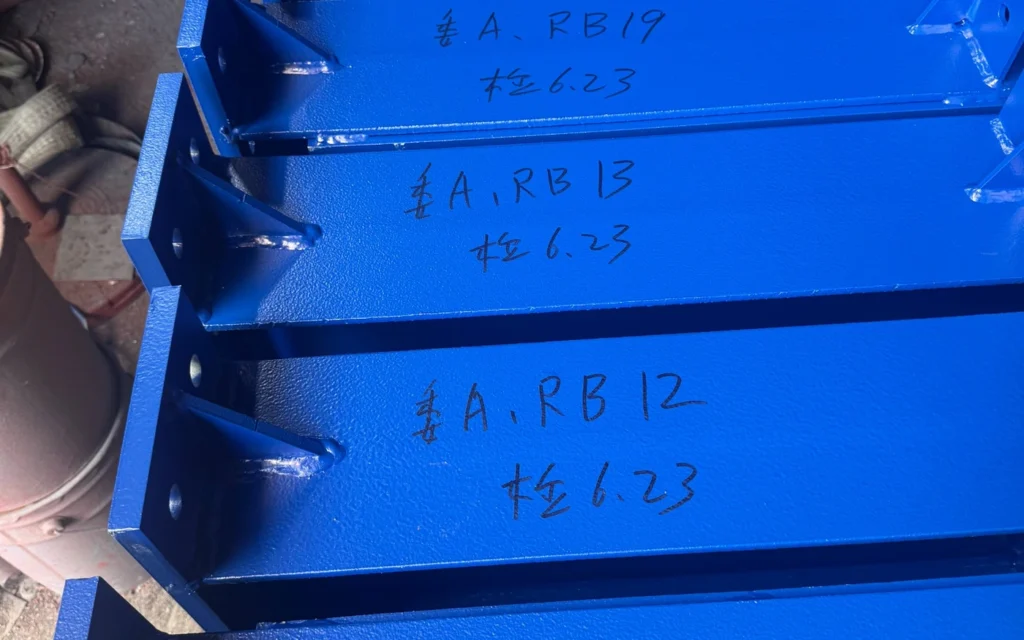
A mill heat or cast identifier and a fabrication piece mark serve different purposes. The first relates to material production; the second identifies a component within fabrication or erection information. Seeing a piece mark on a beam does not, by itself, prove a link to a particular heat.
Agree the required traceability level and the records that will support it. Depending on the contract, the review may connect incoming material identification to cutting or allocation records, fabrication marks and the delivery list. Identify who maintains each link, how split or combined material is handled and what happens if identification is lost.
For steel fabrication from drawings, align document requirements with the approved material schedule and drawing revisions. Ask the supplier which records can actually be provided; do not assume an image of marked steel demonstrates a particular traceability system.
Buyer’s Material Document Review Worksheet
Complete this worksheet for the proposed order. Record unresolved items and the person responsible for closing them before the relevant purchase, fabrication or shipment decision.
| Check | Buyer requirement | Evidence or reference to review | Discrepancy or action |
|---|---|---|---|
| 1. Issuer and integrity | Identify the material manufacturer and document source. | Complete document and a verifiable issuer contact or agreed verification route. | Resolve altered, missing or inconsistent information. |
| 2. Document type | State the required type and governing document edition. | Order requirement, certificate designation and validation details. | Confirm missing inspection arrangements before purchase. |
| 3. Product specification | Define product form, grade, standard and delivery condition. | Approved order, material schedule and applicable specification. | Obtain approval for any proposed substitution. |
| 4. Heat or batch identity | Define the required material-identification link. | Certificate identifiers and receipt or allocation records. | Investigate unmatched identifiers; do not infer a match. |
| 5. Dimensions and quantity | Identify ordered sizes and the material covered. | Certificate entries, purchase records and delivery information. | Explain partial deliveries or allocation across orders. |
| 6. Chemical analysis | Identify the specified composition requirements. | Recorded analysis and the relevant material specification. | Refer omissions or deviations to the responsible reviewer. |
| 7. Mechanical results | Define required properties and test conditions. | Results, units, test conditions and applicable thickness range. | Clarify missing tests or an incompatible acceptance basis. |
| 8. Fabrication link | Agree the required level of component traceability. | Available cutting, allocation and piece-mark records. | Name the party responsible for an incomplete link. |
| 9. Delivery link | Identify documents required with each shipment. | Packing list, component schedule and document index. | Reconcile the actual shipment, not only the total order. |
| 10. Review and release | Assign acceptance authority and required review points. | Open-item register, approvals and agreed delivery procedure. | Record the decision, owner and outstanding restrictions. |
MTCs, Weld UT Reports and Finished-Steel Inspections Are Different Records
Material documents address the steel identified in those records. Ultrasonic weld inspection addresses the documented welds, method and inspection scope. It does not independently establish the base-metal grade or certify an entire building. Bingfa’s customer-requested third-party UT inspection case illustrates a project-specific inspection, not a universal inspection package.
Finished-steel inspection can cover agreed dimensions, coating, identification and packing. Use the pre-shipment quality inspection checklist for that separate stage. A complete purchase may need several complementary records; one should not be presented as a substitute for another.
Agree on Document Requirements in the RFQ
Include the material specification, requested inspection-document type, traceability level and any purchaser review or witnessing requirements in the RFQ. State the language, delivery format, submission timing and who reviews exceptions. Confirm additional inspection costs and responsibilities rather than assuming they are included in a steel price.
Bingfa manufactures steel components in Guangdong, China, and supplies steelwork and agreed enclosure systems. Available documentation and any additional inspection arrangements must be confirmed for the particular order. There is no blanket promise here that every order includes EN 10204 3.1, 3.2 or an identical traceability level.
Frequently Asked Questions
Is a 3.1 certificate always sufficient for structural steel?
No single document type is suitable for every purchase. Check the applicable product specification, contract and project requirements with the responsible technical reviewer before ordering.
Does a fabricated component mark identify its steel heat?
Not necessarily. A piece mark normally identifies the fabricated component. The required connection to material identifiers must be supported by the agreed records.
Can a weld UT report replace a mill test certificate?
No. They answer different questions. UT findings relate to the inspected welds and recorded scope; material documents identify and report information about the steel.
What should I send with an initial enquiry?
Send the project location, intended use, main dimensions, available drawings and known material-document requirements. Complete construction drawings are not required for an initial discussion, but unresolved specifications must be confirmed before an order is finalized.
A useful document package begins with an explicit requirement and ends with records that can be reconciled to the supplied material. Bring those requirements into the quotation discussion, not only the final shipment review.