A steel fabrication request for quotation (RFQ) may include drawings, a bill of quantities (BOQ), a member schedule and specifications that disagree. Two suppliers can then return different prices because they have priced different requirements.
Steel fabrication RFQ clarification connects each discrepancy to a written question, an appropriately authorized response and a visible quotation basis. It helps buyers see what has been priced, what remains unresolved and whether quotations can be compared. It does not replace engineering review or authorize fabrication.
Verify the RFQ Document Set and Revisions
Start with a document register. For each drawing, BOQ, member schedule, specification and addendum, record its reference, revision, issue date, issuer, stated purpose and applicable building area or supply package.
A newer timestamp does not automatically supersede every earlier file. A revised schedule may cover only one package; an addendum may change a specification without reissuing drawings. Confirm the intended quotation set through the applicable project instructions.
A BOQ and member schedule may organize information differently, and neither should be assumed exhaustive. A member shown on a drawing but absent from the BOQ needs clarification; its absence is not permission to exclude it silently.
For missing inputs, use the separate guide to information needed for a steel building quote. This guide addresses inconsistencies within the documents already supplied.
Identify the Type of Conflict Before Comparing Prices
Separate three situations before asking suppliers to price them:
- Contradiction: two references state incompatible requirements for the same item, such as different member sizes or coating systems.
- Missing information: a requirement or item is absent. A missing quantity, connection requirement or inspection detail does not establish a zero-cost inclusion or an exclusion.
- Proposed alternative: a different material or configuration is deliberately offered for review. Keep it separate from the original basis; see original and alternative material quotations.
Check steel grade, quantity, dimensions, coating, connections, enclosure scope and inspection requirements. These categories can interact: a size discrepancy may also affect connections and quantities.
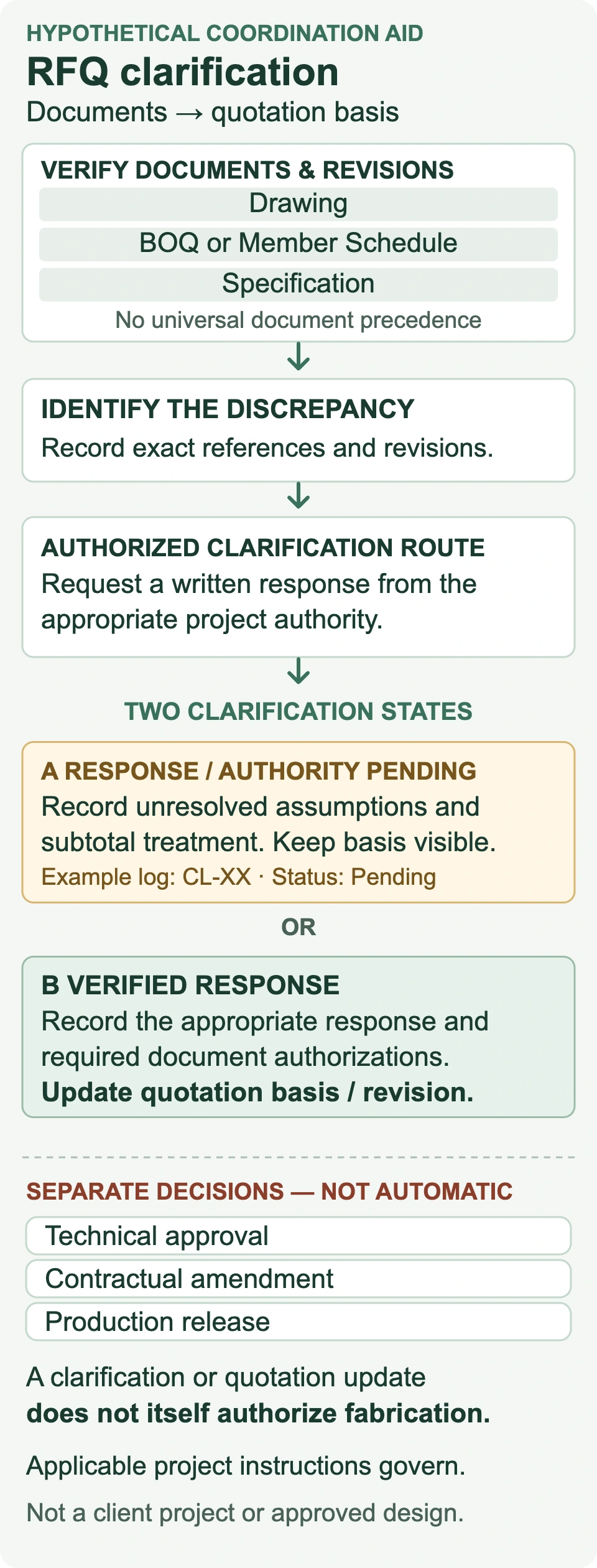
There is no universal order of precedence between drawings, BOQ and specifications. Follow the applicable contract and project instructions, and seek clarification from the designated authority. Choosing the heavier member, supposedly higher standard or cheaper requirement does not resolve the conflict.
Request Written Clarification from the Appropriate Project Authority
Cite both conflicting references and revisions, including the relevant member mark, detail, line or clause. Describe the difference neutrally, ask a specific question and identify the affected quotation scope.
The buyer can coordinate the question, but technical changes to steel grades, dimensions, connections and specifications require the competent party authorized under the project arrangements. Quantity reconciliation may involve the BOQ originator and commercial representatives; any design effects still need the responsible technical review. A purchasing email is not automatically an engineering approval.
Record the response reference, date, issuer, authority and applicable scope. Distinguish a received response from a verified quotation basis. A clarification does not automatically amend a contract, revise production documents or release fabrication.
Bingfa can review relevant information within its proposed fabrication and supply scope and raise clarification questions. This does not guarantee detection of every error or authorize Bingfa to change a third party’s design. Any separately agreed design or detailing role needs its own defined responsibilities.
Use a Pre-Quotation Clarification Log
Use one issue per row and cross-reference related issues. The following log is a suggested buyer tool, not a statement of Bingfa’s mandatory operating procedure.
Hypothetical example only: all document identifiers and revisions below are fictional. Grade A/B and Size A/B are placeholders, not material standards or recommended alternatives. No technical answer, quotation or production release has been approved. The responsible-party entries indicate proposed review routes; actual authority remains to be confirmed.
| Issue ID | Document Reference | Revision | Discrepancy | Responsible Party | Status | Authorized Clarification | Quotation Assumption | Potential Impact | Quotation Revision |
|---|---|---|---|---|---|---|---|---|---|
| CL-01 — Grade | Drawing D-S-01; specification SP-01, grade clause | Drawing B; specification C | Drawing states Grade A; specification states Grade B for the same member. | Buyer coordinates; authorized material/design reviewer confirms; supplier assesses supply. | Pending | Pending | Basis Pending; affected scope Not Yet Priced, outside subtotal. | Pending: material basis, price and affected quantities. | Pending |
| CL-02 — Quantity | Drawing D-S-01, member mark; BOQ BQ-01, item list | Drawing B; BOQ A | A depicted member is missing from the BOQ. | BOQ originator and responsible designer reconcile; supplier reviews quantities. | Pending | Pending | Basis Pending; affected scope Not Yet Priced, outside subtotal. | Pending: quantity, price and associated connection scope. | Pending |
| CL-03 — Size | Member schedule MS-01; drawing D-S-01, same member mark | Schedule A; drawing B | Drawing states Size A; schedule states Size B. | Authorized designer confirms; supplier assesses fabrication effects. | Pending | Pending | Basis Pending; affected scope Not Yet Priced, outside subtotal. | Pending: member quantities, connections and price. | Pending |
| CL-04 — Coating | Specification SP-01, coating clause; drawing D-S-01, finish note | Specification C; drawing B | Drawing calls for paint; specification calls for galvanizing. | Authorized specifier/design reviewer confirms; supplier reviews treatment scope. | Pending | Pending | Basis Pending; affected scope Not Yet Priced, outside subtotal. | Pending: treatment scope, affected items and price. | Pending |
| CL-05 — Connections | Drawing D-S-01, joint detail; specification SP-01, connection clause | Drawing B; specification C | Drawing shows a bolted joint; specification requires welding. | Authorized connection designer confirms; supplier reviews fabrication scope. | Pending | Pending | Basis Pending; affected scope Not Yet Priced, outside subtotal. | Pending: connection components, fabrication scope and price. | Pending |
| CL-06 — Enclosure | BOQ BQ-01, panel items; specification SP-01, package scope | BOQ A; specification C | BOQ includes wall panels; specification describes structural-steel-only supply. | Buyer and authorized scope representatives clarify; designer reviews interfaces. | Pending | Pending | Basis Pending; affected scope Not Yet Priced, outside subtotal. | Pending: panel quantities, interfaces, scope and price. | Pending |
| CL-07 — Inspection | Specification SP-01, inspection clause; BOQ BQ-01, inspection item | Specification C; BOQ A | Specification requires third-party witnessing, while the BOQ lists only routine factory checks and does not identify whether witnessing is included or separately priced. | Designated project quality/specification authority confirms; supplier reviews requirements. | Pending | Pending | Basis Pending; affected scope Not Yet Priced, outside subtotal. | Pending: inspection scope, affected items and price. | Pending |
“Pending” means unknown, not zero or no impact. The examples leave affected scope unpriced; they do not establish that the whole package is unpriceable. Identify any unaffected priced scope separately.
When completing a real log, replace placeholders with exact references. Record each response and its authority check, then the pricing assumption, subtotal treatment and quotation reference/revision/date. Keep response received, basis verified and reflected in quotation as separate recorded steps. None of those recorded steps, by itself, authorizes fabrication or production release.
Tell us which document versions and unresolved requirements affect the fabrication package you want quoted, so we can review the proposed supply scope.
Keep Unresolved Assumptions and Subtotals Visible
A pricing assumption is a stated commercial basis awaiting confirmation, not a technical solution. Use clear quotation states:
- Included: priced and included in the stated current subtotal.
- Provisional: a provisional basis or allowance, with the unresolved requirement identified. State explicitly whether the amount is included in the current subtotal; it is not a final confirmed price or technical approval.
- Optional — Separately Priced: outside the base subtotal unless expressly selected into an identified scenario. State its inclusion and avoid adding it twice.
- Not Yet Priced: not included in the priced subtotal. It is neither free nor automatically excluded from the proposed supply scope.
- Excluded: expressly outside the offered supply scope and its subtotal.
Identify dependencies. An unresolved connection or material requirement may affect other members and packages, so flag their provisional basis or unpriced status too. If affected items remain unpriced, describe the subtotal as incomplete for the requested package.
Keep alternative configurations and their subtotals separate. Do not combine the lowest individual lines into a total that no supplier offered. This does not require disclosure of every component’s unit price. For broader offer comparisons, compare steel structure quotation scope alongside the clarification record.
Update the Document Basis and Quotation Revision Together
When clarification changes an issued quotation’s basis, quantity, price or scope, identify the revised quotation and the response supporting it. Record any updated drawings, specifications or formal instructions required by the project process. Retain superseded versions and explain what changed. A clarification with no quotation impact can be recorded without automatically reissuing the quote.
Give affected bidders a consistent authorized basis through the project communication route, without disclosing another bidder’s confidential pricing.
Technical clarification, contractual amendment and production release are separate decisions. Quotation acceptance does not by itself settle unresolved design requirements or release fabrication. Production needs sufficiently confirmed information and completion of the agreed release procedure.
Use drawing review before fabrication for the later approval stage. If work has already passed that stage, follow the separate guidance on drawing changes after approval, rather than treating the change as an ordinary pre-quotation question.
Confirm Bingfa’s Supply Scope and EXW Quotation Boundary
Bingfa normally bases supply quotations on EXW. Freight and other services are separately quoted when requested and agreed. State the named place, actual supply scope and any separately agreed loading or export-handling arrangements. An EXW supply quotation is not the complete project cost.
The agreed package may include columns, beams or rafters, bracing, connection components and secondary steel. Roof and wall cladding, sandwich panels, roof gutters and rainwater downpipes are included only where agreed. Surface treatment, inspection, identification and packing requirements also need an explicit basis. This does not imply ground or underground drainage works.
Keep foundations, local civil works, specialist MEP, regulatory approvals and other parties’ design responsibilities separate. Engineers may provide agreed overseas technical guidance, subject to project needs, personnel availability and applicable local requirements. The customer generally organizes local installation workers and covers travel expenses; service fees, installation scope and site responsibilities are separately agreed.
Review structural steel fabrication from drawings for the fabrication offer and steel building services for agreed support options. Neither makes optional services part of every materials quotation.
Final Checklist Before Comparing Steel Fabrication Quotations
Before accepting a comparison, check:
- Are suppliers using the same identified RFQ documents, revisions and applicable clarifications?
- Is each conflict resolved for quotation or visibly marked Pending?
- Are response authority and any required document updates recorded?
- Are pricing assumptions and dependent quantities, prices and scope identified?
- Are Included, Provisional, Optional, Not Yet Priced and Excluded items distinguishable?
- Does each provisional or optional amount state its subtotal treatment?
- Are incomplete subtotals and alternative scenarios clearly separated?
- Can each change be traced to the quotation revision that reflects it?
- Are technical decisions, contract changes and production release still treated separately?
Share the RFQ basis, unresolved questions and requested supply scope so we can discuss what can be quoted and what still needs authorized clarification.