
DATA CENTER ENCLOSURE
Data Center Sandwich Wall Panels: Fire, Thermal & Service-Penetration Coordination
Compare sandwich wall panel options for data-center and server-room enclosures, including fire documentation, thermal and moisture inputs, joints, openings and service penetrations.
Quick Answer: Which Wall Panel Fits a Data Center?
There is no universal “best” sandwich wall panel for every data center. Selection should follow confirmed fire-related requirements, thermal criteria, moisture conditions, service-penetration strategy, joint details and project scope. EPS, PU/PIR and Rock Wool panel systems have different characteristics and documentation requirements. The appropriate panel should be confirmed against the actual project requirements and applicable specialist criteria rather than selected from a generic recommendation.
Why Data-Center Wall Panels Need Different Coordination
A data-center or server-room enclosure differs from a generic warehouse wall. The critical differences include continuous enclosure integrity, high concentration of services, cable routes, pipe routes, duct routes, equipment openings, doors, louvers, thermal continuity and specialist fire-stop interfaces. The wall panels must be coordinated around these service interfaces before fabrication. A generic warehouse panel specification may not address the specific coordination requirements of a data-center enclosure. The panel system, joints, openings and service penetrations should be reviewed together before finalising the enclosure design.
EPS, PU/PIR and Rock Wool Panel Selection
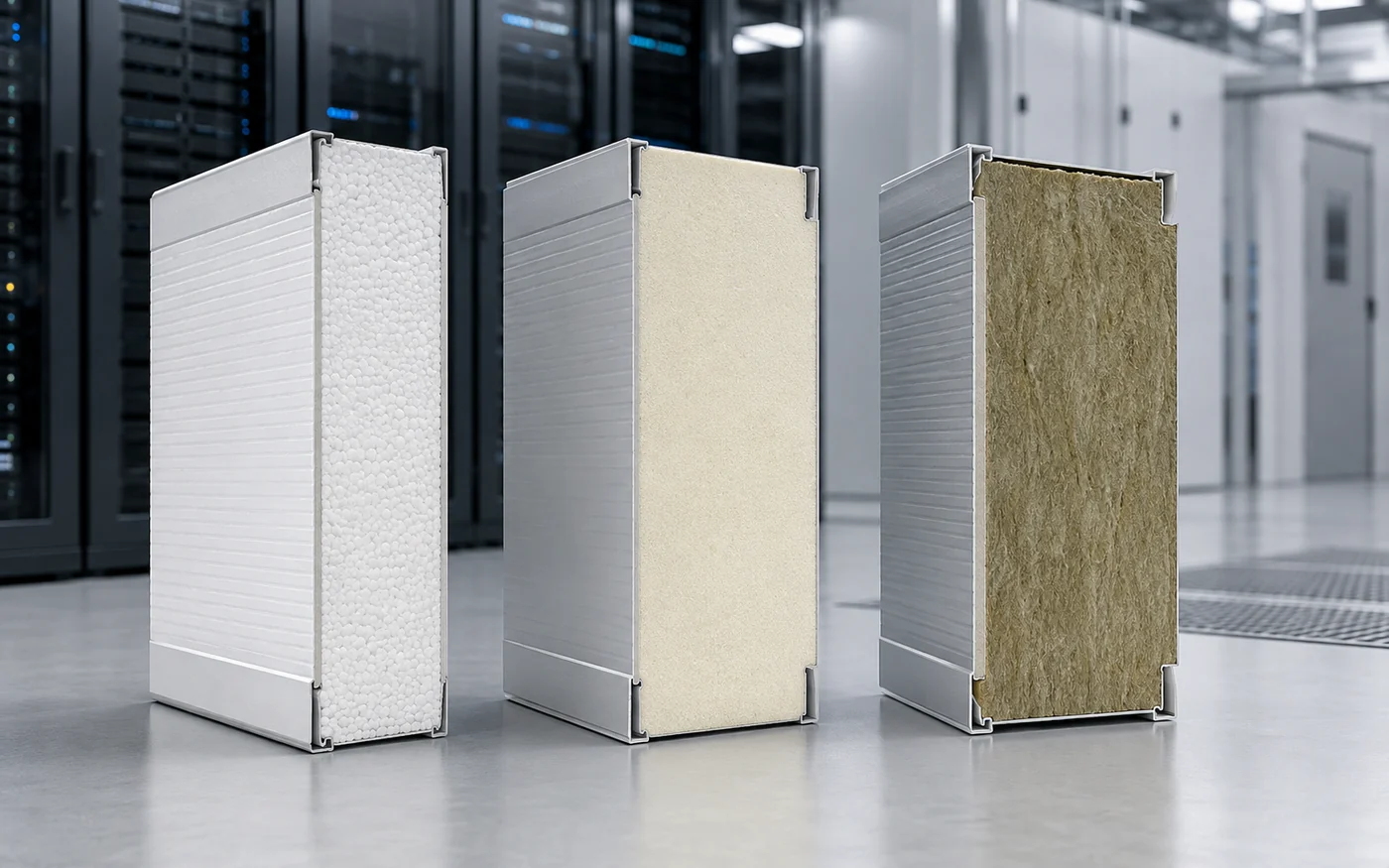
For broader material selection guidance, the sandwich panel materials page provides additional context. The following table offers a general comparison of the three main panel families often considered for data-center applications. The final selection should be based on confirmed project requirements rather than a generic preference.
| Panel Family | Why It May Be Considered | What Must Be Confirmed |
|---|---|---|
| EPS | Lightweight insulated enclosure option; procurement and general enclosure considerations | Confirm project-specific fire requirements, thermal criteria, joints, openings and supporting documentation |
| PU / PIR | Often considered where thermal-insulation performance is an important project input | Confirm the exact product system, thermal and fire-related documentation, moisture criteria and availability. Do not assume PU and PIR are identical. |
| Rock Wool | Often considered where fire-related documentation is an important selection factor | Confirm the complete panel assembly, test documentation, joints, support conditions and project acceptance requirements |
EPS Wall Panels
EPS sandwich wall panels are a lightweight insulated enclosure option for general building use. Where EPS is considered for a data-center application, buyers should confirm the project-specific fire and thermal requirements. Joints, openings and service interfaces should be coordinated around the selected panel system. EPS may not be appropriate for every data-center application. The final panel selection should be confirmed based on the project requirements and supporting documentation.
PU and PIR Wall Panels
PU sandwich panels and PIR systems are commonly considered for thermal-insulation-oriented applications. PU and PIR are related but different product systems with different formulations. Buyers should confirm the specific panel system, product documentation and project requirements before selection. PU or PIR systems may also be considered depending on the confirmed project requirements and available panel system. Joint and opening coordination should be reviewed for the selected panel type.
Rock Wool Wall Panels
Rock wool sandwich wall panels may be considered where fire-related documentation is especially important. However, rock wool does not automatically satisfy every project fire requirement. The required panel system, assembly, test documentation and project acceptance must be confirmed. Rock wool panels have different weight, handling and installation characteristics compared to foam-core systems. The project team should verify that the selected panel system meets the specific data-center requirements.
Fire-Performance Requirements and Supporting Documents
Core material alone is not enough to confirm fire-related performance. Buyers may need to confirm panel-system test documentation, assembly configuration, joint details, support conditions, openings, penetrations, doors and interfaces, and local project requirements. The required fire-performance documentation should be confirmed for the actual project and supplied panel system. Final fire engineering and acceptance remain specialist-led. This guide does not provide fire ratings, compliance assertions or performance guarantees.
Thermal, Condensation and Moisture Inputs
Data-center enclosures may require specific thermal and moisture performance. Buyers should confirm required thermal performance, indoor and outdoor design conditions, temperature differences, humidity, condensation risk, vapor-control strategy and joint continuity. The required thermal target, vapor-control criteria and HVAC design conditions should come from the project’s specialist design team. Bingfa can then coordinate the selected panel system and enclosure interfaces against those confirmed requirements.
Wall Joints and Enclosure Continuity
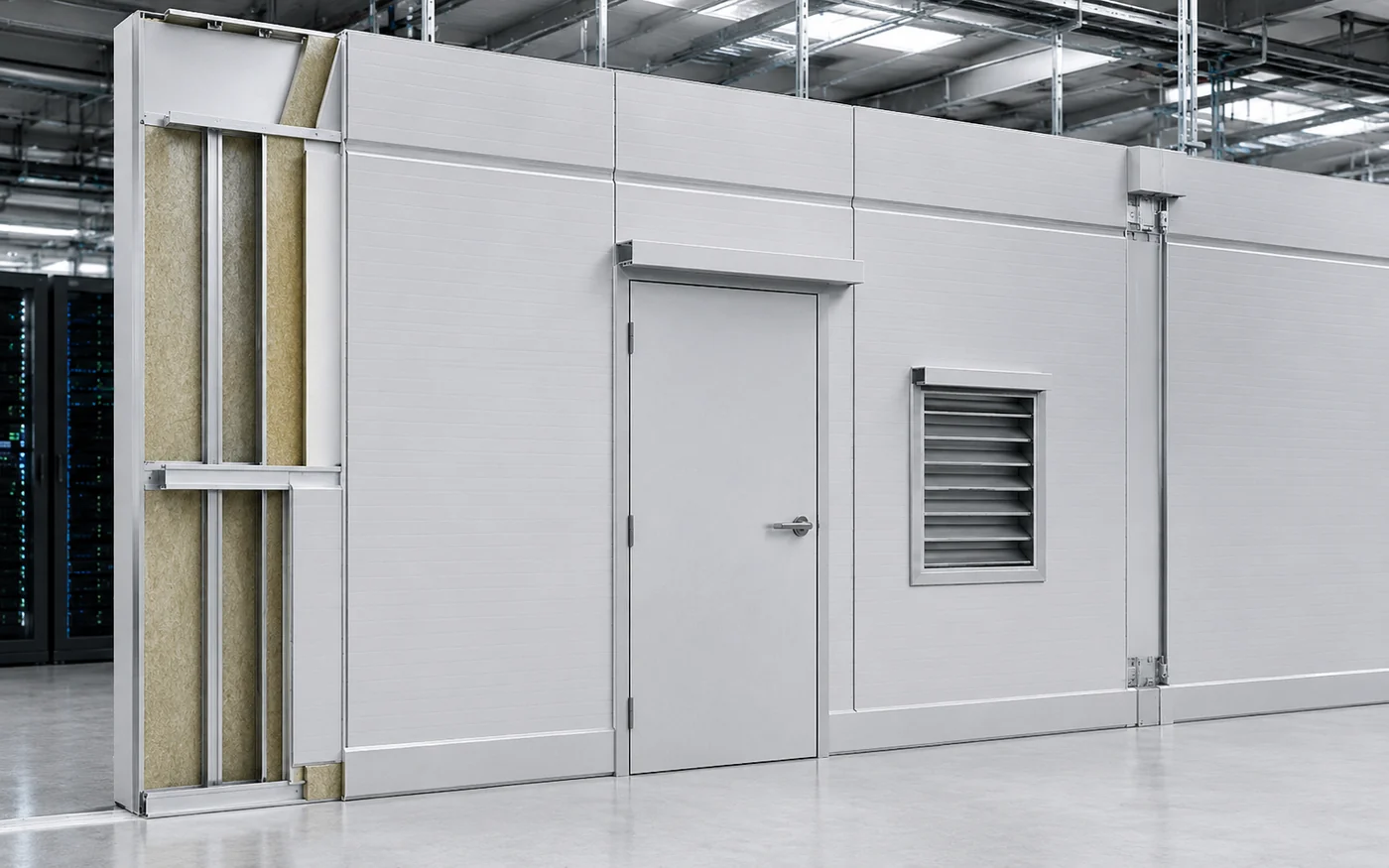
Panel-to-panel joints, corner details, base interface, top interface, junction with steel framing, trim and flashing, and sealant and gasket concepts all affect enclosure performance. Continuity around openings should be coordinated before fabrication. Small interface details matter for overall enclosure performance. This guide does not guarantee airtightness or provide fixed joint-performance values.
Cable, Pipe and Duct Penetrations
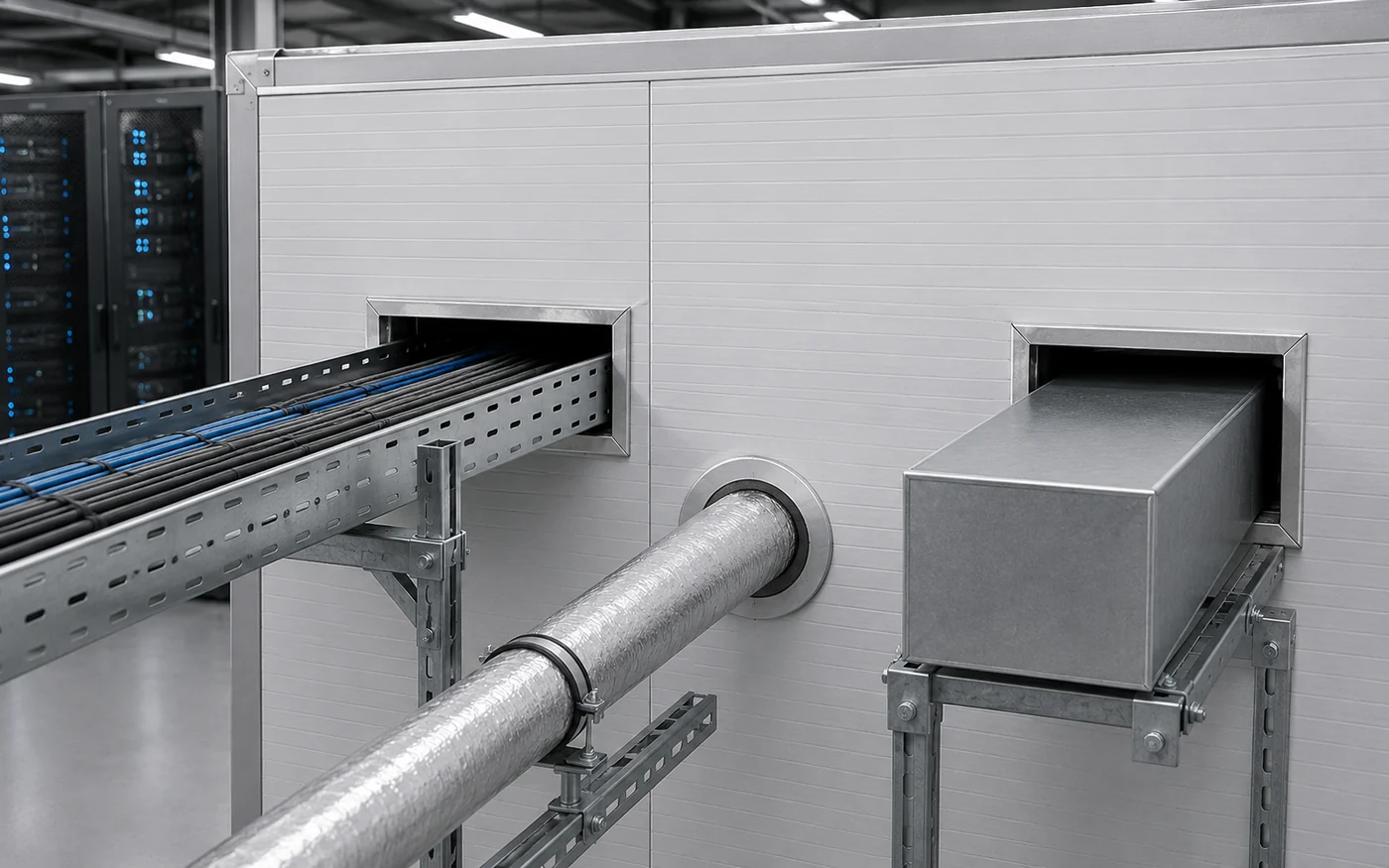
Service penetrations should be coordinated before panel fabrication. For a broader view of how service openings are coordinated with steel building systems, the steel building service penetrations guide provides additional detail.
Confirm Opening Locations Before Panel Fabrication
Opening size, position, quantity, service route, clearance and secondary support should be coordinated early. Penetration information should be provided before panel fabrication where available. Late changes to opening locations may affect panel layout and fabrication.
Panel Cut Edges, Trims and Sealing
Cut-edge protection, trim, closure, seal and panel core exposure should be coordinated for all service penetrations. The cut-edge detailing should be reviewed based on the specific panel type and penetration location. This guide does not provide a universal cut-edge construction detail.
Secondary Framing Interfaces
Some penetrations or equipment openings may require framing and support coordination. Large openings or heavy equipment interfaces may require additional support. The secondary framing arrangement should be reviewed before fabrication.
Specialist Fire-Stop Requirements
Penetration fire stopping is specialist-led. The panel opening and structural and enclosure interface can be coordinated, but the approved fire-stop system must follow the relevant specialist design and project requirements. Fire-stop design, approved fire-stop systems and specialist installation remain outside the panel-supply responsibility unless they are specifically included in the confirmed project scope.
PLANNING A DATA-CENTER ENCLOSURE?
Review Your Wall Panel Requirements
Share your drawings, wall dimensions, openings and confirmed project requirements so we can review the panel and enclosure supply scope.
DISCUSS YOUR PANEL REQUIREMENTSDoors, Louvers and Equipment Interfaces
Personnel doors, equipment doors, louvers, large service openings and equipment interfaces affect panel module placement, joint positions, secondary steel, trims, sealing and installation sequence. Door and louver requirements should be confirmed before panel fabrication. Equipment interfaces should be coordinated with the enclosure layout. Ventilation and airflow requirements remain part of the specialist MEP design, while the panel layout can be coordinated around confirmed louver and opening information.
Installation and Trade-Coordination Boundaries
Coordination responsibilities should be clearly understood among the steel contractor, panel supplier, MEP contractor, fire-stop specialist, door and louver supplier, and project designer. Opening schedules and interface information should be agreed before fabrication where possible. Responsibilities between the panel supplier and other trades should be defined in the confirmed project scope, including who provides opening information, specialist sealing systems, installation work and interface details.
Information Buyers Should Provide Before Quotation
- Project location
- Wall areas and dimensions
- Drawings
- Required panel type if already specified
- Thermal requirements if confirmed
- Fire-related requirements and documents if specified
- Wall height
- Panel orientation if confirmed
- Door, louver and equipment opening schedule
- Cable, pipe and duct penetration information
- Finishes and colors
- Accessory and trim requirements
- Supply scope
- Installation responsibility
- Project schedule
The more complete the information, the more accurately the panel scope can be coordinated. For a broader overview of how buyers navigate project coordination, the steel building procurement process guide offers useful context.
FAQ
1. Which sandwich panel core is best for a data center?
There is no single best core material for every data-center application. EPS, PU/PIR and Rock Wool panel systems have different characteristics and documentation requirements. The appropriate panel should be selected based on the confirmed fire-related requirements, thermal criteria, moisture conditions and project scope rather than a generic recommendation.
2. Are EPS sandwich panels suitable for server rooms?
EPS may be considered for some applications, but suitability depends on the project-specific fire and thermal requirements. EPS is a lightweight enclosure option, but it should not be assumed to be appropriate for every server room. The project requirements should be confirmed before panel selection.
3. Does a rock wool panel automatically satisfy data-center fire requirements?
No. Rock wool panels are commonly considered where fire-related documentation is especially important, but they do not automatically satisfy every project fire requirement. The required panel system, assembly, test documentation and project acceptance must be confirmed for the specific project.
4. How should thermal performance be confirmed?
Thermal performance should be checked against the project’s required thermal target, the exact selected panel system, relevant supplier technical documentation, and joint and assembly conditions where relevant. The required thermal target should come from the project’s specialist design requirements rather than from a generic assumption.
5. Who is responsible for penetration fire stopping?
Penetration fire stopping is specialist-led. The approved fire-stop system must follow the relevant specialist design and project requirements. The panel opening and structural interface can be coordinated, while fire-stop design and specialist installation remain outside the panel-supply responsibility unless they are specifically included in the confirmed project scope.
6. What information is needed to quote data-center sandwich wall panels?
Buyers should provide the project location, wall areas and dimensions, drawings, required panel type if already specified, thermal and fire-related requirements if confirmed, door and louver schedules, cable and pipe penetration information, finishes, accessory and trim requirements, supply scope, installation responsibility and project schedule. Complete project information enables a more accurate quotation.
PROJECT INQUIRY
Request a Data-Center Wall Panel Review
Share your confirmed wall-panel requirements, drawings, openings and project scope for an initial supply review.
REQUEST A PROJECT REVIEW